How AI is changing wordpress seo?
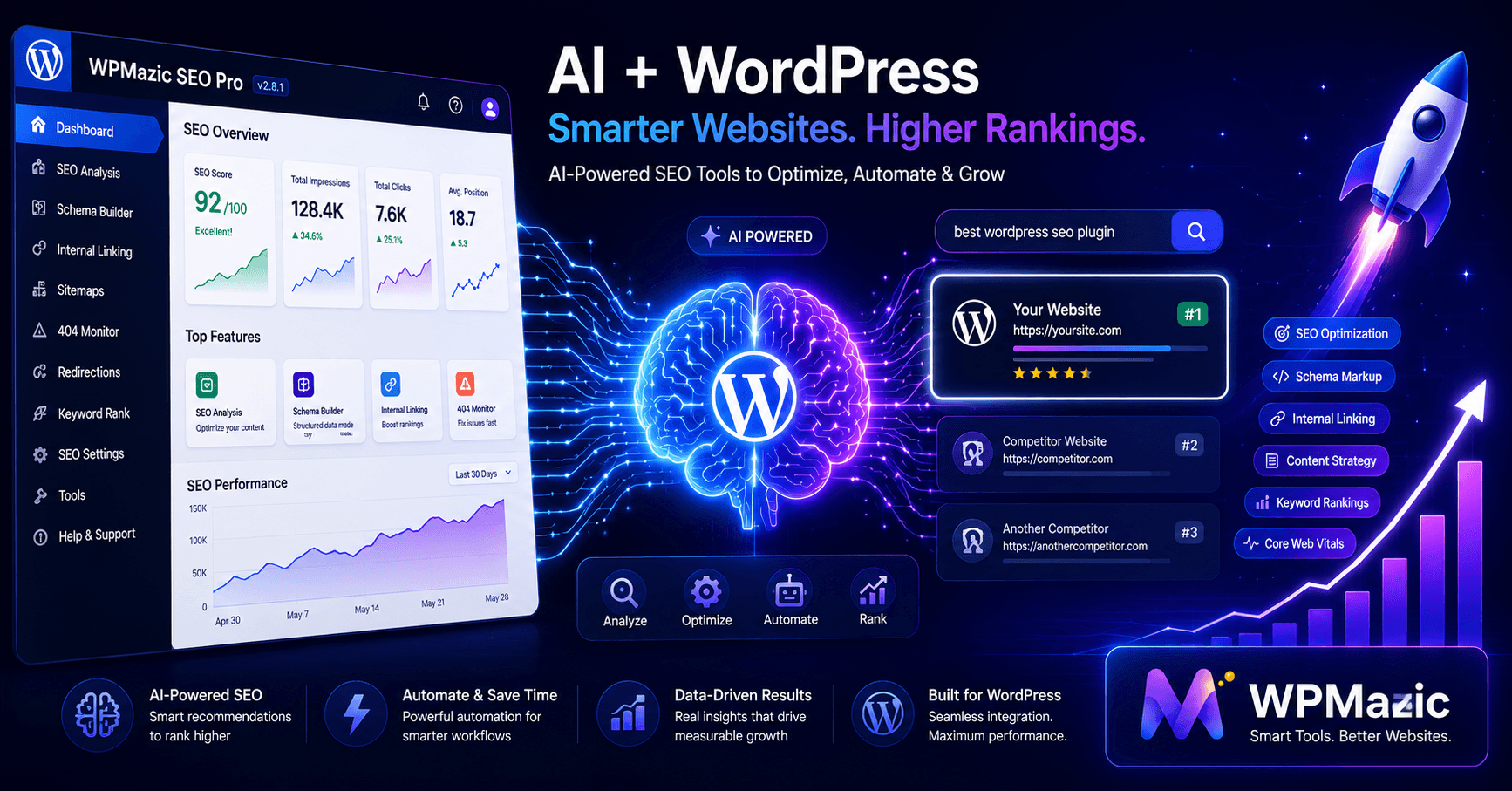
Not too long ago, doing SEO for your WordPress website meant a fairly predictable routine: find a keyword, write a blog post, add a meta description, build a few backlinks, and wait. That playbook still has value — but the game has fundamentally changed. Artificial intelligence has entered the picture, and it's rewriting the rules of search from the ground up.
Google is no longer just a search engine. It's an AI-powered answer engine. The way people search, the way content is ranked, the way Google interprets your pages — all of it is being redefined by machine learning, natural language processing, and large language models. And if you're running a WordPress website, you need to understand what that means for your SEO strategy right now.
The good news? AI isn't just disrupting SEO — it's also creating extraordinary opportunities for WordPress users who know how to leverage it. The right AI-powered tools can help you rank faster, write better content, fix technical issues automatically, and appear in Google's AI Overviews — a new class of search real estate that most website owners haven't even started optimizing for.
In this comprehensive, no-fluff guide, we'll break down exactly how AI is transforming every dimension of WordPress SEO, what you need to do differently today, and how tools like the WPMazic SEO Plugin are helping WordPress users navigate this new AI-first search landscape with confidence.
Whether you're a complete beginner, a blogger, a developer, or a business owner — by the end of this guide, you'll have a clear, actionable picture of AI-powered WordPress SEO in 2026 and exactly what you need to do to stay ahead of the curve.
1. The AI Revolution in Search: What Actually Changed
To understand where we're going, it helps to understand how dramatically things have shifted. SEO in 2016 was largely mechanical. You optimized for keywords, acquired links, and made sure your pages loaded quickly. Google's algorithm was sophisticated, but it was still largely pattern-matching text and counting signals.
Fast-forward to 2026, and Google's core ranking system is built on deep learning models that understand language almost the way humans do. The algorithm doesn't just read your words — it understands the intent behind your content, the context in which topics exist, the relationships between concepts, and the quality of the experience your page delivers to real users.
The Key AI Technologies Reshaping Search
Several distinct AI technologies are driving this transformation:
- Machine Learning (ML): Google's RankBrain (launched 2015) was one of the first ML systems embedded in the core ranking algorithm. It learns from how users interact with search results and uses those behavioral signals to refine rankings over time. Today, ML is woven throughout every layer of Google Search.
- Natural Language Processing (NLP): Google's BERT (2019) and MUM (2021) models transformed how Google interprets the actual meaning of queries and content. BERT analyzes every word in context — understanding that "bank" means different things in "river bank" vs. "bank account." MUM takes this further, processing information across images, video, and text simultaneously.
- Large Language Models (LLMs): The explosion of LLM technology (GPT-series, Gemini, Claude) has fed directly into how Google generates AI Overviews, ranks authoritative content, and interprets natural language queries. Google's Gemini model now powers core search features including AI Overviews, Featured Snippets, and conversational search.
- Predictive Analytics: AI systems predict what a user is likely to want next based on their query, browsing history, location, and device — enabling hyper-personalized search results that differ from one user to the next even for the same query.
- Computer Vision: Google Lens and image search capabilities powered by AI now make visual content a genuine SEO channel — images, infographics, and videos are analyzed and ranked with increasingly sophisticated understanding.
What This Means for WordPress SEO in Plain English
Here's the practical takeaway for WordPress site owners: you can no longer trick or game the algorithm with simple tactics. Keyword stuffing, low-quality backlink schemes, thin content padded with filler paragraphs — these strategies don't just fail to work today, they actively hurt your rankings. Google's AI systems are designed specifically to detect and penalize manipulative tactics.
But — and this is the crucial flip side — genuinely good content, genuine expertise, and genuine value for your audience are rewarded more richly than at any point in SEO history. AI has made Google better at identifying quality, which means honest, expert-driven content strategies are more effective and more durable than ever.
💡 Key Insight: "AI is not replacing SEO — it's making it smarter. Marketers who embrace AI will dominate search rankings in the next few years." The opportunity is real, but only for those willing to adapt.
2. Google AI Overviews & SGE: The New SEO Battleground
If you've done a Google search recently, you've almost certainly seen them: those large, AI-generated answer blocks that appear at the very top of search results, above all the organic links. These are Google AI Overviews (previously called Search Generative Experience or SGE), and they represent the single most significant shift in how search results work in the past decade.
What Are Google AI Overviews?
AI Overviews are synthesized answers generated directly by Google's Gemini AI model in response to a search query. Rather than just showing a list of links, Google now reads multiple authoritative sources, synthesizes the key information, and presents a comprehensive answer directly in the search results — often with citations to the source pages.
This creates a profound shift in the SEO landscape:
- Zero-click searches increase: For many informational queries, users get their answer directly from the AI Overview without clicking any link at all
- New citation opportunity: Pages cited within AI Overviews can receive significant visibility and traffic, even without ranking in the traditional top 10
- Content format matters more than ever: Google's AI prefers clearly structured, factually accurate, comprehensively sourced content that directly answers specific questions
- Authority signals are amplified: AI Overviews heavily favor content from authoritative, trustworthy sources — making EEAT (Experience, Expertise, Authority, Trust) more critical than ever
How to Optimize Your WordPress Site for AI Overviews
Getting cited in Google AI Overviews is becoming one of the most valuable SEO goals for WordPress publishers. Here's how to increase your chances:
- Write definitive, comprehensive answers: AI Overviews pull from content that thoroughly addresses a topic. Shallow, surface-level content rarely gets cited. Aim to be the most complete resource on your topic.
- Use clear question-and-answer structure: Structure sections of your content around specific questions your audience asks. Use the question as a heading (H2 or H3) and answer it directly and completely in the following paragraph.
- Implement FAQ schema markup: Structured data helps Google's AI understand which parts of your content are questions and answers. Tools like WPMazic SEO Plugin make adding FAQ schema completely code-free.
- Cite authoritative sources: Link out to reputable sources (government sites, research institutions, established publications). This signals to Google's AI that your content is factually grounded and trustworthy.
- Use factual, specific language: AI models favor precise, specific, well-sourced statements over vague or generic claims. Include data, statistics, dates, and specific examples wherever possible.
- Maintain fresh, updated content: AI Overviews prefer current information. Regularly update your most important posts with the latest data and developments.
- Optimize for "answer blocks": Structure key answers in 40-60 word summaries that directly and completely answer a single question — the same technique that wins Featured Snippets also improves AI Overview citation rates.
The Evolving Search Results Page in 2026
| SERP Feature | Powered By | SEO Opportunity |
|---|---|---|
| AI Overview | Google Gemini AI | Get cited as a source in AI-generated answers |
| Featured Snippet | ML + NLP | Own Position Zero with direct, concise answers |
| People Also Ask | ML + User behavior | Answer related questions to capture PAA boxes |
| Knowledge Panel | Knowledge Graph AI | Schema markup + authority signals |
| Local Pack | ML + Location AI | LocalBusiness schema + Google Business Profile |
| Image Results | Computer Vision AI | Optimized images with alt text and image schema |
| Video Results | ML + Video AI | VideoObject schema + YouTube optimization |
| Traditional Blue Links | Core ranking AI | Full on-page + off-page SEO strategy |
3. How AI Is Transforming Keyword Research for WordPress
Keyword research used to be a fairly linear process: you'd open a tool like Google Keyword Planner, type in a broad topic, sort by search volume, pick the highest-volume keywords you had a realistic chance of ranking for, and start writing. That approach still works at a basic level — but it leaves a massive amount of opportunity on the table.
AI-powered keyword research tools have fundamentally changed what's possible. Instead of just showing you search volume numbers, modern AI keyword tools analyze why people search for specific terms, how those terms relate to each other conceptually, which topics dominate a niche versus which have untapped potential, and what the searcher is most likely to do next after getting their answer.
AI-Powered Keyword Research Capabilities
Search Intent Classification
AI tools automatically classify every keyword by search intent — informational, navigational, commercial investigation, or transactional. This is critical because publishing the wrong content type for a keyword's intent is one of the most common reasons pages fail to rank. If the top results for a keyword are all "best of" comparison lists and you publish a product page, you'll struggle regardless of how well your page is otherwise optimized.
Semantic Keyword Clustering
AI groups related keywords into semantic clusters — groups of keywords that share meaning and search intent even when the specific words differ. Instead of treating "WordPress SEO plugin," "best SEO plugin for WordPress," and "SEO plugin WordPress free" as three separate targeting opportunities, AI shows you they're all part of the same cluster and can be addressed on a single well-optimized page.
This is enormously valuable for WordPress content strategy because it helps you:
- Avoid creating competing pages for the same topic (keyword cannibalization)
- Understand which keywords to combine on one page vs. separate into distinct posts
- Identify the primary keyword that should lead a cluster and the secondary keywords that support it
Competitive Gap Analysis
AI tools can automatically scan your competitors' content and identify keywords they're ranking for that you aren't — surfacing opportunities you'd never discover through manual research. More importantly, they can identify keywords where the existing top-ranking content is weak or outdated — your best opportunities to enter a competitive space and win.
Long-Tail Keyword Discovery at Scale
Long-tail keywords (specific, lower-volume phrases) are where most new and mid-authority WordPress sites should focus their SEO energy. They're less competitive, more conversion-friendly, and AI tools can now identify thousands of valuable long-tail opportunities in minutes — work that would have taken weeks manually.
Practical Example: AI Keyword Research in Action
Let's say you run a WordPress website about personal finance and you're targeting the broad topic of "budgeting." Without AI, you might identify a handful of keywords manually:
- budgeting tips
- how to create a budget
- personal budgeting
An AI-powered keyword tool would map the entire topic cluster for "budgeting" — perhaps 200-400 semantically related keywords — and reveal intent-grouped subclusters like:
- Informational cluster: "what is zero-based budgeting," "envelope budgeting method explained," "50/30/20 budget rule"
- Tool-seeking cluster: "best budgeting apps 2026," "free budget spreadsheet template," "budgeting app for couples"
- Problem-solving cluster: "how to stick to a budget when income is irregular," "budgeting tips for single parents," "how to budget when you're living paycheck to paycheck"
Each cluster represents a distinct content opportunity — and AI would show you which ones have the best combination of search volume, competition level, and relevance to your specific audience.
AI Keyword Research Tools Worth Using
- Semrush Keyword Magic Tool: AI-powered intent classification and semantic clustering at scale
- Ahrefs Keywords Explorer: Parent topic identification and traffic potential modeling
- Google Search Console (free): Real data on what queries are already driving impressions to your site — integrate with WPMazic SEO Plugin for dashboard access
- Google's "People Also Ask" & "Related Searches": Free AI-curated intent signals hiding in plain sight on every SERP
- ChatGPT / Gemini: Useful for brainstorming semantic variations and question-format keywords your target audience might search
4. AI-Powered Content Optimization: Beyond Basic Keywords
Writing content for SEO used to mean hitting a certain keyword density and making sure your target phrase appeared in the title, headings, and first paragraph. That's table stakes today — necessary but nowhere near sufficient. Modern AI-powered content optimization is about comprehensiveness, semantic relevance, topical authority, and real user value.
How AI Analyzes and Scores Content Quality
Google's AI systems evaluate content along multiple dimensions simultaneously:
- Topical completeness: Does this piece of content cover the topic as thoroughly as the user needs? Does it address related subtopics and questions that someone researching this topic would naturally have?
- Semantic richness: Does the content use the vocabulary, concepts, and terminology that genuine experts in this field naturally use? Or does it read like keyword-stuffed content written by someone with no real expertise?
- Factual accuracy: Are the claims in this content consistent with established facts from authoritative sources? (Google's AI increasingly cross-references content against its knowledge base.)
- Readability and structure: Is the content organized logically? Can a user quickly find the specific information they need? Is the writing clear, appropriately detailed, and accessible?
- User engagement: Based on behavioral signals from users who reach this page, do they find what they're looking for? Do they stay, scroll, and engage — or do they bounce back to the search results immediately?
The Content Optimization Workflow with AI
Here's a practical AI-powered content optimization workflow for WordPress users:
- Research phase (AI-assisted):
- Identify your focus keyword and intent cluster
- Study the top 5-10 currently ranking pages for your target keyword
- Use an AI tool to identify all subtopics and semantic keywords covered by the top-ranking pages
- Note which questions in People Also Ask are related to your topic
- Planning phase:
- Create a comprehensive outline that covers all identified subtopics
- Plan your heading structure (H1 → H2 → H3) to create a logical, crawlable hierarchy
- Identify where to include FAQ sections, tables, lists, and step-by-step guides
- Writing phase (human-led, AI-assisted):
- Write your content naturally, prioritizing value and clarity over keyword repetition
- Incorporate semantic keywords and related terms organically — not forcibly
- Include specific examples, data points, and expert insights that add genuine authority
- Optimization phase (WPMazic SEO Plugin):
- Set your focus keyword in WPMazic's editor panel
- Review WPMazic's real-time SEO analysis and address flagged issues
- Optimize your SEO title and meta description with WPMazic's live preview
- Enable appropriate schema markup (Article, FAQ, HowTo) through WPMazic
- Check readability score and simplify any flagged sections
- Post-publication phase:
- Monitor performance in Google Search Console (accessible via WPMazic dashboard)
- Update content within 6 months based on actual search query data
- Expand sections where users are spending the most time
The Danger of Pure AI Content Generation
Here's something important that doesn't get said often enough: using AI to write your content entirely, without human editing, expertise, and added value, is one of the worst SEO strategies you can pursue in 2026.
Google has become extremely sophisticated at identifying generic, AI-generated content that lacks original perspective, genuine expertise, and real-world experience. Pure AI content tends to be factually safe but intellectually bland — it covers the basics of a topic without adding anything that a genuinely knowledgeable human author would bring. This directly conflicts with Google's EEAT guidelines, which we'll explore in detail later in this guide.
The winning approach is human expertise amplified by AI tools — not AI content with a human name slapped on it. Use AI to research, outline, identify gaps, and optimize. Use your own knowledge, experience, and perspective to write content that genuinely helps your specific audience in ways that generic AI output never could.
5. Natural Language Processing (NLP) & Semantic SEO
One of the most profound shifts AI has brought to SEO is the move from keyword-matching to meaning-matching. This is the domain of Natural Language Processing — the branch of AI that enables computers to understand, interpret, and generate human language.
How NLP Changed Google's Understanding of Content
Before BERT (Google's NLP breakthrough in 2019), Google largely matched keywords. You searched for "best hiking boots waterproof" and Google looked for pages containing those exact words in those approximate positions. BERT changed this entirely — it allowed Google to understand the full context of a query and the full meaning of a page's content.
Today, Google doesn't just read your page — it understands your page. It knows the difference between:
- "Can you recommend a good Python developer?" (programming language) vs. "Can you recommend a good python handler?" (snake)
- "Apple releases new iPhone" (technology company) vs. "Apple releases new variety" (fruit)
- "How to fix a leaking tap" (plumbing) vs. "Tap dancing lesson" (dance)
This disambiguation happens automatically, entirely based on surrounding context — no keyword tags or manual signals needed.
What Semantic SEO Means for Your WordPress Content
Semantic SEO is the practice of optimizing your content for meaning and context, not just keywords. It means:
- Covering topics, not just keywords: A semantically optimized page about "content marketing" should naturally include discussion of buyer personas, editorial calendars, content distribution, conversion funnels, and measurement — because these are the concepts that genuinely belong to the topic. A page that only mentions "content marketing" repeatedly without discussing its real constituent parts looks hollow to NLP systems.
- Using natural synonyms and variations: Don't force the same keyword phrase into every paragraph. Use natural variations: "WordPress SEO," "search engine optimization for WordPress," "optimize your WordPress site for Google" — these are all semantically equivalent and their natural variation signals authentic, human-written content.
- Building topical authority through content clusters: Publishing multiple, deeply interlinked pieces of content on related topics within your niche builds what Google's AI recognizes as topical authority — a clear signal that your site is a genuine expert resource on this subject area, not a thin affiliate site trying to rank for a handful of terms.
- Entity optimization: Google's Knowledge Graph identifies "entities" — specific people, places, organizations, products, and concepts — and understands the relationships between them. Optimizing for entities means making it crystal clear what your content is about at the entity level: who wrote it, what organization it represents, what specific products or topics it covers.
Practical NLP Optimization Tips for WordPress
- Use your focus keyword in the title, first paragraph, and at least one H2 heading — but don't repeat it robotically throughout the text
- Naturally include 10-20 semantically related terms throughout your content (LSI keywords)
- Write in complete, grammatically correct sentences — NLP models process sentence structure, not just word presence
- Use clear, specific language — vague phrases like "many experts say" or "it is widely known" are weak signals; name the experts, cite the studies, specify the data
- Structure content to answer questions directly and completely — question + clear answer is exactly the format NLP systems are trained to recognize and reward
6. AI Automating Technical SEO on WordPress
Technical SEO — the behind-the-scenes work of ensuring search engines can efficiently find, crawl, render, and index your website — has traditionally been one of the most daunting aspects of WordPress optimization. It involves crawl budget management, canonical URL configuration, schema markup implementation, page speed optimization, and a dozen other considerations that require both technical knowledge and consistent attention.
AI is dramatically reducing the manual effort required for technical SEO by automating detection, diagnosis, and often the fix itself.
AI-Powered Crawl Analysis
Modern AI crawl tools don't just list technical errors — they prioritize them by impact. Instead of presenting you with a 500-item list of issues to wade through, AI-powered auditing tools analyze your site's structure and traffic data together to identify which technical problems are actually costing you rankings and which are low-priority noise. This is a game-changer for WordPress site owners who have limited time for technical maintenance.
Automated Schema Markup Generation
Implementing JSON-LD structured data manually requires understanding the Schema.org vocabulary, writing syntactically correct code, and verifying it against Google's Rich Results standards. AI-powered plugins — including WPMazic SEO Plugin — automate this entirely. They detect your content type, select the appropriate schema, populate the required fields from your existing content, and inject the validated JSON-LD into your page without you writing a single line of code.
Core Web Vitals Monitoring and Optimization
Google's Core Web Vitals — LCP (Largest Contentful Paint), INP (Interaction to Next Paint), and CLS (Cumulative Layout Shift) — are confirmed ranking factors that measure real-world page performance. Historically, diagnosing and fixing Core Web Vitals issues required significant developer expertise. AI tools are increasingly able to:
- Automatically identify which specific elements are causing poor LCP scores
- Detect layout shift sources and suggest CSS fixes
- Recommend JavaScript deferral and preloading strategies to improve INP
- Compress and convert images to next-gen formats (WebP, AVIF) automatically
- Generate critical CSS to improve perceived load performance
Intelligent Internal Linking
Internal links are one of the most powerful — and most neglected — SEO tools available to WordPress users. A well-structured internal link network helps Google understand your site's architecture, distributes page authority efficiently, and helps users discover related content they'll find valuable.
AI-powered internal linking tools (like Link Whisper for WordPress) analyze your existing content library and automatically suggest contextually relevant internal link opportunities as you write. They identify orphaned pages (content with no internal links pointing to it), find pages that could benefit from receiving more link equity, and suggest anchor text variations that look natural to both users and Google's algorithms.
AI and Duplicate Content Detection
WordPress is notoriously prone to duplicate content issues — category archives, tag pages, pagination, author archives, and URL parameter variations can all create near-identical content visible to search engines. AI crawl tools now automatically identify and map these duplicate content patterns, and plugins like WPMazic SEO Plugin automatically apply canonical tags to resolve them — protecting your rankings without requiring any manual intervention.
7. How AI Improves User Experience Signals for SEO
Google's AI systems don't just analyze your content in isolation — they analyze how real users interact with it. Behavioral signals like time on page, scroll depth, click-through rate, and return-to-SERP rate are all fed into Google's machine learning systems as quality signals. Pages that consistently deliver what searchers are looking for get rewarded; pages that disappoint users get demoted.
This means that improving your actual user experience is no longer just a nice-to-have UX concern — it's a core SEO strategy.
AI-Powered Personalization
WordPress sites can leverage AI to deliver personalized content experiences that reduce bounce rates and increase engagement. Tools powered by AI can recommend related articles based on reading behavior, adjust content presentation based on device type and user preferences, and surface the most relevant products or services to each individual visitor based on their browsing patterns.
When users spend more time on your site and engage more deeply with your content, those positive behavioral signals feed back into Google's AI ranking systems — creating a virtuous cycle where better user experience leads to better SEO, which brings in more qualified visitors, which further improves your engagement signals.
AI Chatbots and On-Site Search
AI-powered chatbots on WordPress sites serve dual purposes: they improve user experience by helping visitors find what they need quickly, and they can collect valuable data about what users are searching for on your site — insights you can use to identify content gaps and optimize existing pages. Sites with effective on-site search capabilities see significantly lower bounce rates than those without, and that reduction in bounce rate signals quality to Google.
Content Layout Optimization
AI tools can analyze user behavior data (scroll maps, click maps, engagement time) and provide actionable recommendations for improving how your content is laid out and presented. Moving key information higher on the page, breaking up long paragraphs, adding visual breaks, or restructuring headings for better scannability — these seemingly minor changes can have surprisingly significant impacts on time-on-page metrics and the behavioral signals Google uses to judge content quality.
8. Voice Search & Conversational AI: Optimizing for How People Actually Talk
Voice search was supposed to be the "next big thing" in SEO for several years before it actually became mainstream. Now, with smart speakers in tens of millions of homes, voice assistants integrated into every smartphone, and AI-powered voice interfaces embedded in cars, TVs, and wearables, voice search is simply a fact of modern search behavior — and it demands a meaningfully different optimization approach.
How Voice Search Differs from Text Search
When people type a search query, they tend to use abbreviated, keyword-style phrases: "best pizza restaurant near me." When they speak a query, they use natural, complete sentence structures: "Hey Google, what's the best pizza restaurant near me that's open right now?" This distinction has significant implications for how you structure your WordPress content.
| Aspect | Text Search | Voice Search |
|---|---|---|
| Query length | 2-4 words typically | 7-10+ words typically |
| Sentence structure | Keywords, fragments | Full, conversational sentences |
| Question format | Rare | Very common (who, what, where, when, why, how) |
| Local intent | Common | Very common ("near me," "open now") |
| Results displayed | Full SERP page | Single spoken answer (usually from Position Zero) |
| Content type preferred | Various | Concise, direct answers; FAQ format |
Voice Search Optimization Strategies for WordPress
- Write in natural, conversational language: Your content should read the way a knowledgeable person would explain something to a friend — not the way a robot would recite keywords. This naturally aligns with how voice queries are phrased.
- Create dedicated FAQ content: Voice search assistants predominantly pull answers from FAQ-format content and Featured Snippets. Including comprehensive FAQ sections on your WordPress pages — properly marked up with FAQ schema via WPMazic — is one of the highest-leverage voice search optimization tactics available.
- Target question-format keywords: Use keyword research tools to find the most common questions people ask about your topics (What is…? How do I…? Where can I find…? Why does…?). Create content that directly and completely answers each question.
- Optimize for local voice search: "Near me" voice queries are extremely common for local businesses. Ensure your WordPress site has accurate LocalBusiness schema, your Google Business Profile is fully optimized, and your content explicitly mentions your location, service area, and opening hours.
- Keep answers concise: The ideal Featured Snippet (the primary source for voice search answers) is 40-60 words. Practice writing tight, complete answers that fit this format.
- Prioritize page speed: Voice search results heavily favor fast-loading pages. A slow WordPress site is at a significant disadvantage for capturing voice search traffic.
9. AI and the Future of Link Building
Backlinks — links from other websites pointing to yours — remain one of Google's most important ranking signals. But AI is changing both how link building is done and how Google evaluates the links you earn.
How AI Is Changing Link Evaluation
Google's AI systems have become vastly better at distinguishing earned, editorially placed links from manipulative, artificially acquired links. Link farms, private blog networks (PBNs), mass guest posting schemes, and paid link placements are more reliably detected and discounted (or penalized) than ever before. The AI models look at patterns — the velocity of link acquisition, the context in which links appear, the topical relevance between linking and linked pages, and the authority signals of the linking domains — to make nuanced judgments about link quality that simple algorithmic rules could never achieve.
What this means practically: you simply cannot buy your way to lasting rankings in 2026. The only sustainable link building strategy is earning links by creating genuinely valuable content and building genuine relationships with other publishers in your space.
AI-Assisted Link Building for WordPress
While the nature of link building has become more human-centric, AI tools can significantly improve the efficiency of legitimate link building strategies:
- Prospect identification: AI tools can analyze thousands of websites in your niche to identify the most promising link prospects based on domain authority, topical relevance, and engagement metrics
- Content gap analysis for link-worthy content: AI identifies which types of content earn the most backlinks in your niche, helping you create link-worthy resources proactively
- Broken link discovery: AI crawlers can identify broken external links across thousands of sites, surfacing opportunities to reach out with your content as a replacement
- Outreach personalization: AI writing tools help craft personalized outreach messages at scale, improving response rates
- Link monitoring: AI tools continuously monitor your backlink profile and alert you to lost links, toxic links, and new linking opportunities in real time
10. Predictive SEO: Using AI to Stay Ahead of Trends
One of AI's most exciting applications in SEO is its ability to analyze vast amounts of data and identify emerging trends before they peak. Predictive SEO means positioning your content for keywords and topics that are starting to gain momentum — and being the established authority when the traffic wave arrives — rather than chasing trends after everyone else has already jumped on them.
How Predictive SEO Works
AI predictive tools analyze signals from multiple data sources simultaneously:
- Google Trends trajectory data (acceleration of search volume, not just current volume)
- Social media conversation volume and sentiment for emerging topics
- News and media coverage patterns
- Seasonal patterns from historical search data
- Competitor content publication timing
- Industry event calendars and product launch schedules
By synthesizing these signals, AI tools can identify keywords that are currently low-volume but trending upward — often 2-6 months before they become highly competitive. Publishing authoritative content on these topics early gives your WordPress site a significant ranking advantage: you accumulate backlinks, establish topical authority, and build a traffic history on the keyword before most of your competitors even recognize the opportunity.
Practical Predictive SEO for WordPress Users
- Monitor Google Trends regularly: Set up alerts for your core topics and watch for sustained upward movement. A keyword with 1,000 monthly searches but 40% month-over-month growth is often more valuable than a keyword with 10,000 monthly searches and flat or declining trend.
- Watch your industry's early adopters: Identify 5-10 blogs and publications that consistently break news in your niche. When they start covering a new topic heavily, that's an early signal worth acting on.
- Mine "People Also Ask" for emerging questions: Questions appearing in PAA boxes often reflect emerging user needs that haven't yet been well served by existing content — prime opportunities for fresh, authoritative content.
- Refresh and expand existing content proactively: Use WPMazic's SEO Health Dashboard to identify pages that are declining in rankings. Often, a comprehensive content refresh based on current search intent data can fully recover and often exceed previous rankings.
11. The Best AI-Powered SEO Tools & Plugins for WordPress
The WordPress ecosystem has responded rapidly to the AI revolution, with a growing library of AI-powered plugins and tools that automate, enhance, and streamline SEO workflows. Here's a curated overview of the most valuable ones for WordPress users in 2026:
AI SEO Plugins for WordPress
| Plugin / Tool | Primary AI Function | Best For | Cost |
|---|---|---|---|
| WPMazic SEO Plugin | On-page analysis, schema markup, content scoring, GSC integration | All WordPress users — beginners to pros | Free / Premium |
| Rank Math AI | AI content suggestions, automated schema, keyword tracking | Advanced users wanting AI content scoring | Free / Premium |
| Yoast SEO Premium | AI-powered content recommendations, internal linking | Established blogs and business sites | Premium |
| Link Whisper | AI internal link suggestions | Sites with large content libraries | Premium |
| Surfer SEO | NLP content optimization, SERP analysis | Content writers and SEO agencies | Premium |
| NitroPack | AI-powered Core Web Vitals optimization | Speed optimization for any site | Free / Premium |
| ShortPixel | AI image compression and WebP conversion | Image-heavy WordPress sites | Free / Premium |
| Semrush / Ahrefs | AI keyword research and competitor analysis | Advanced keyword and backlink strategy | Premium |
Free AI Tools for WordPress SEO (No Plugin Required)
- Google Search Console: The most important free SEO tool — integrates directly with WPMazic for in-dashboard access to your actual search performance data
- Google Rich Results Test: Validate your schema markup implementation
- Google PageSpeed Insights: AI-powered Core Web Vitals analysis with specific fix recommendations
- Google Trends: Monitor keyword trend trajectories for predictive SEO
- Bing Webmaster Tools: Free technical SEO insights and indexing control for Bing (often overlooked but valuable)
- ChatGPT / Gemini (free tier): Useful for keyword brainstorming, outline creation, and semantic keyword variation generation
12. How WPMazic SEO Plugin Prepares You for the AI-First Search Era
Having a powerful AI strategy for SEO is only as good as the tools you use to implement it on your WordPress site. This is where the WPMazic SEO Plugin plays a crucial role — providing the structural foundation that makes AI-era SEO practical and achievable for every WordPress user, regardless of technical skill level.
WPMazic and AI Overviews: Being Citable
To get cited in Google's AI Overviews, your content needs to be clearly structured, semantically well-organized, and properly marked up with structured data. WPMazic helps you achieve all three:
- FAQ schema automation: Add FAQ sections to your content and WPMazic automatically generates the correct JSON-LD markup — making your Q&A content visible and parseable to Google's AI models
- Article and BlogPosting schema: Proper article schema markup signals content type, publication date, author authority, and publisher information — all factors that influence AI Overview citation decisions
- Breadcrumb schema: Well-defined site structure through breadcrumb markup helps Google's AI understand where each piece of content sits within your overall topic hierarchy
WPMazic's Real-Time Content Scoring for AI-Era SEO
WPMazic's on-page SEO analysis goes beyond basic keyword checking to evaluate the semantic richness and structural quality of your content — the factors that modern AI-driven ranking systems actually reward:
- Checks for keyword presence in contextually important locations (title, intro, headings)
- Evaluates content length against topic competitiveness benchmarks
- Analyzes heading structure for logical hierarchy and keyword inclusion
- Assesses readability using Flesch-Kincaid scoring
- Flags thin content, missing alt text, and absent internal/external links
- Monitors focus keyword uniqueness across your entire content library to prevent cannibalization
WPMazic's GSC Integration: Data-Driven AI SEO
One of WPMazic's most powerful features for AI-era SEO is its Google Search Console integration. By surfacing your actual search performance data — impressions, clicks, CTR, average position, and top performing queries — directly in your WordPress dashboard, WPMazic enables the kind of data-driven optimization that AI-powered SEO demands. You can identify exactly which of your pages Google's AI is showing in search results and optimize those pages for maximum click-through rate and AI Overview citation potential.
WPMazic's Technical SEO Foundation
For Google's AI systems to find, crawl, understand, and rank your content, your WordPress site needs a solid technical foundation. WPMazic provides that foundation automatically:
- Advanced XML sitemaps submitted to Google and Bing — ensuring complete content discovery
- Automatic canonical tag management — eliminating duplicate content that confuses AI ranking systems
- Robots.txt management — controlling which content AI crawlers can and cannot access
- Redirect management — maintaining link equity across content restructuring
- 404 error monitoring — preventing crawl waste on broken URLs
- Social meta tags — ensuring correct content representation across AI-powered social platforms
Visit wpmazic.com to explore all features and get started today.
13. EEAT in the Age of AI: Why Human Expertise Still Wins
EEAT — Experience, Expertise, Authority, and Trust — is Google's quality framework for evaluating content creators and websites. Introduced as EAT and expanded to EEAT, these principles have become increasingly central to Google's AI-powered quality assessments, particularly in the wake of the flood of low-quality AI-generated content that has hit the web over the past two years.
What Each EEAT Signal Means in Practice
- Experience: Does the content creator have first-hand, real-world experience with the topic? A review written by someone who actually used the product carries more EEAT weight than a review compiled from other sources. Google's AI is increasingly able to detect the difference.
- Expertise: Does the author have demonstrable knowledge and skill in the subject area? Formal credentials matter for YMYL (Your Money or Your Life) topics like health, finance, and legal advice. For other topics, demonstrated depth of knowledge and quality of analysis serves as the expertise signal.
- Authority: Is this site or author recognized as a credible, authoritative source within its niche? Authority is built through backlinks from reputable sources, mentions in industry publications, author bylines on authoritative sites, and the breadth and depth of your content library on your core topics.
- Trust: Is this site transparent, accurate, and safe? Clear author attribution, accurate and sourced factual claims, secure HTTPS connection, clear contact information, published privacy policy, and a track record of editorial corrections all contribute to trust signals that Google's AI evaluates.
How to Build EEAT on Your WordPress Site
- Create detailed author profiles: Each author on your site should have a comprehensive bio page that establishes their credentials, experience, and expertise. Link to their social profiles, published works, and professional profiles.
- Use Person schema markup: WPMazic supports Person schema, which helps Google's Knowledge Graph identify and verify your authors as authoritative entities.
- Cite your sources: Every factual claim should be supported by a link to an authoritative source. This isn't just good journalism — it's a strong EEAT signal.
- Publish a clear editorial policy: Explain how content on your site is created, reviewed, and updated. This transparency significantly boosts trust signals.
- Show your real-world experience: Include personal anecdotes, case studies, original research, and first-hand observations in your content — the specific details that only someone with genuine experience can provide.
- Keep content current and accurate: Stale, inaccurate content is a direct EEAT negative. Use WPMazic's content audit features to identify outdated posts and refresh them regularly.
- Build topical authority before breadth: It's better to be deeply authoritative on a focused set of topics than to publish superficially across dozens of unrelated subjects. Google's AI is designed to recognize genuine topical expertise.
EEAT and AI-Generated Content: The Critical Balance
Here's the fundamental tension of content creation in 2026: AI can help you produce more content more efficiently, but it cannot manufacture the genuine experience, expertise, and original perspective that EEAT requires. The most effective WordPress content strategy uses AI as a research, optimization, and efficiency tool while ensuring that every published piece reflects genuine human knowledge, experience, and editorial judgment.
⚠️ Important Warning: Publishing purely AI-generated content without human expertise, review, and added value doesn't just risk low rankings — it risks Google's manual quality reviews and potential site-wide demotion for systematic thin content violations. Always lead with human expertise; use AI to amplify it, not replace it.
14. Common AI SEO Mistakes WordPress Users Make
Understanding what to do is only half the battle. Knowing what not to do with AI in your WordPress SEO strategy is equally important. Here are the most common and costly mistakes to avoid:
Mistake #1: Publishing AI Content Without Editing
The mistake: Using AI content generators to write entire posts and publishing them with minimal or no human editing, fact-checking, or expertise addition.
Why it hurts: Google's quality systems detect generic, unremarkable AI content — particularly its lack of specific experience, original perspective, and genuine depth. This content might rank briefly but consistently underperforms long-term and risks triggering quality penalties at scale.
The fix: Use AI for research, outlining, and drafting only. Always rewrite in your authentic voice, add original insights and experience, verify all facts, and ensure the final content genuinely helps your audience better than any competing page.
Mistake #2: Over-Relying on AI SEO Scores as the Sole Quality Metric
The mistake: Optimizing content purely to achieve a high score in an AI SEO analysis tool, at the expense of natural readability and genuine user value.
Why it hurts: A perfect SEO score on thin, robotic content is worthless. Google's user experience signals (time on page, bounce rate, return-to-SERP rate) will quickly push that content down regardless of its technical optimization score.
The fix: Use SEO analysis tools like WPMazic as a guide, not a mandate. Aim for a good score on content that genuinely reads well and delivers value — not technically perfect scores on content that doesn't serve the reader.
Mistake #3: Ignoring AI Overviews
The mistake: Continuing to optimize exclusively for traditional blue-link rankings without any strategy for appearing in AI Overviews, Featured Snippets, or People Also Ask.
Why it hurts: For many high-value informational queries, AI Overviews now dominate the top of the page. Sites that only optimize for traditional rankings are invisible for an increasingly large segment of search queries.
The fix: Include dedicated question-and-answer sections in your content, implement FAQ schema via WPMazic, and structure your most important answers in concise 40-60 word blocks designed to earn AI Overview citations.
Mistake #4: Neglecting Structured Data
The mistake: Not implementing schema markup because it seems technical or unnecessary.
Why it hurts: Structured data is the language that Google's AI uses to understand your content with certainty. Without it, you're relying on Google's AI to infer what your content is about — and that inference is always less reliable than explicit markup. You miss out on rich results, AI Overview citations, and Knowledge Panel features.
The fix: Use WPMazic SEO Plugin to automatically implement schema markup across your entire WordPress site — no coding required. It takes minutes to set up and the SEO benefits persist for the lifetime of your site.
Mistake #5: Keyword Research Without Intent Analysis
The mistake: Choosing keywords based purely on search volume without understanding the search intent behind them.
Why it hurts: Creating a blog post for a keyword that searchers intend to satisfy with a product page, or creating a product page for a keyword where searchers want educational content, is one of the most common and entirely avoidable reasons pages fail to rank.
The fix: Before creating any content, search your target keyword in Google and study the top 5-10 results. The format, content type, and approach of those pages directly reflects what Google's AI has determined best serves that intent. Match that format.
Mistake #6: Forgetting That AI Changes Search, Not SEO Fundamentals
The mistake: Either panicking that "SEO is dead" because of AI, or doing nothing because "AI will figure it out."
Why it hurts: Both extremes miss the point. The foundational principles of SEO — creating genuinely valuable, well-structured, authoritative content that earns legitimate backlinks — have only become more important in the AI era. What's changed is the sophistication with which those principles are evaluated, not the principles themselves.
The fix: Embrace AI as a powerful tool for doing SEO better, not as a reason to abandon SEO or rely on it completely. Human + AI collaboration consistently outperforms either alone.
15. Your AI-Powered WordPress SEO Action Plan for 2026
Let's make this concrete. Here is a prioritized, practical action plan for implementing AI-powered SEO on your WordPress site — whether you're starting from scratch or looking to upgrade an existing strategy.
🚀 Phase 1: Foundation (Week 1-2)
- Install and configure WPMazic SEO Plugin — run the setup wizard, configure sitemaps, enable schema defaults
- Connect to Google Search Console via WPMazic's integration
- Submit your XML sitemap to Google Search Console and Bing Webmaster Tools
- Run a technical SEO audit — identify and fix critical crawl errors, redirect issues, and duplicate content
- Ensure your WordPress theme is mobile-responsive and achieves passing Core Web Vitals scores
📊 Phase 2: Content Audit & Optimization (Week 3-4)
- Use WPMazic's SEO Health Dashboard to identify pages with missing meta descriptions, thin content, and no focus keywords
- Review Google Search Console data for pages with high impressions but low CTR — improve title tags and meta descriptions
- Identify your top 10-20 most visited pages and optimize them for AI Overviews by adding FAQ sections with WPMazic FAQ schema
- Fix orphaned content by adding strategic internal links from related pages
- Update your 5 most important posts with current data, expanded content, and improved structure
✍️ Phase 3: Content Creation Strategy (Month 2-3)
- Use AI keyword tools to map your complete topic cluster — identifying pillar topics and cluster subtopics
- Create or identify your pillar content pages and ensure they are comprehensively optimized
- Develop a publishing calendar targeting long-tail, high-intent keywords within each cluster
- Implement a content creation workflow: AI-assisted research and outline → human writing and expertise → WPMazic optimization → schema markup → GSC performance monitoring
- Begin building topical authority systematically — publish at least 3-5 in-depth cluster articles per month
📈 Phase 4: Authority Building & Amplification (Month 3+)
- Develop a digital PR and link building strategy focused on earning links through genuinely valuable content
- Build out comprehensive author profiles with Person schema markup
- Create original research, data studies, or comprehensive resources that naturally attract backlinks
- Establish a content refresh schedule — review and update your most important pages every 6-12 months
- Monitor your AI Overview citation rate and adjust content structure to maximize citation opportunities
16. The AI WordPress SEO Checklist for 2026
🤖 AI & Search Readiness
- ☐ Site has passing Core Web Vitals scores (LCP, INP, CLS)
- ☐ HTTPS enabled (SSL certificate active)
- ☐ XML sitemap generated and submitted via WPMazic
- ☐ Google Search Console connected (via WPMazic integration)
- ☐ Robots.txt configured correctly (no accidental blocking)
- ☐ Mobile-responsive design verified
- ☐ Canonical tags implemented across all content types (WPMazic)
- ☐ No critical 404 errors in WPMazic's 404 monitor
- ☐ Schema markup active for all major content types (WPMazic)
📝 Content & EEAT
- ☐ Every post has a clearly identified focus keyword (WPMazic)
- ☐ Every post has a unique, optimized SEO title under 60 characters (WPMazic)
- ☐ Every post has a unique meta description 150-160 characters (WPMazic)
- ☐ Author bio pages exist with detailed credentials and Person schema
- ☐ Key factual claims are supported by links to authoritative sources
- ☐ Content includes first-hand experience, original insights, or unique data
- ☐ No pure AI-generated content published without human expertise addition
- ☐ Editorial/content policy published on the site
- ☐ Content updated regularly (stale posts flagged via WPMazic audit)
- ☐ Site has clear contact page, About page, and Privacy Policy
🎯 AI Overview & Featured Snippet Optimization
- ☐ Key pages include dedicated FAQ sections with 5-10 questions
- ☐ FAQ schema enabled via WPMazic on all FAQ-containing pages
- ☐ Important answers structured in concise 40-60 word paragraphs
- ☐ Question-format headings (H2/H3) used throughout content
- ☐ HowTo schema applied to step-by-step guide content
- ☐ Featured image has descriptive, keyword-rich alt text
- ☐ All images have alt text set (WPMazic flags missing alt text)
🔗 Internal Linking & Site Architecture
- ☐ Every new post links to at least 2-3 relevant existing posts
- ☐ Pillar pages link to all related cluster content
- ☐ All cluster posts link back to their pillar page
- ☐ No orphaned content (pages with zero internal links) — checked via WPMazic
- ☐ Breadcrumb navigation enabled with BreadcrumbList schema (WPMazic)
📣 Social & Shareability
- ☐ Open Graph tags configured for Facebook/LinkedIn (WPMazic)
- ☐ Twitter Card tags configured (WPMazic)
- ☐ Custom social sharing image set per key post (WPMazic)
- ☐ Open Graph preview tested with Facebook Sharing Debugger
https://wpmazic.com/how-ai-is-changing-wordpress-seo/?fsp_sid=112

Comments
Post a Comment